Fireside Travels: from Massachusetts to Nether Green via Barker’s Pool

January is a good month for fireside travelers. Written around 1864, Fireside Travels is a collection of essays by the American writer James Lowell in which he shares his experiences of his hometown of Cambridge, Massachusetts and his travels around Italy.

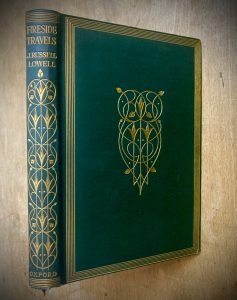
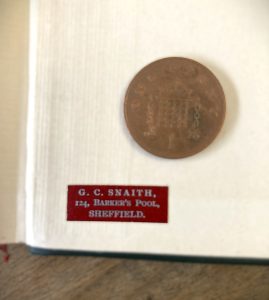
A 1909 green and gilt edition of Fireside Travels currently sits on a stand in our bookshop. Its cover caught my eye with its elegant Art Nouveu design of golden intertwining stems set into dark green cloth. The book’s title was intriguing, but something of even greater interest was to be found on the inside back cover, (the ‘rear pastedown’ in booksellers’ language). Tucked into the bottom left corner is a tiny magenta label with G. C. SNAITH, 124 BARKER’S POOL, SHEFFIELD printed in silver. This sparked my curiosity – I wanted to find out about this Sheffield bookshop from over a century ago.
       

George Collinson Snaith was a bookseller in Barker’s Pool, specifically, “Pool Square”, in the late Victorian and early Edwardian periods. The Picture Sheffield image below shows a row of shops in Pool Square, all of which were demolished in the 1920s to make way for the City Hall.
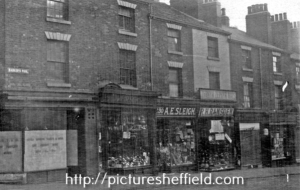
www.picturesheffield.com: image Reference s13277

The left edge of the picture shows the corner with Holly Street and Division Street, probably more or less the location of today’s Women of Steel sculpture. Below the BARKER’S POOL street sign is Robert Cross’ butchers shop, its blinds lowered. Moving right, at number 132, are the Misses J. A. and M.E. Peirson, florists, while A. E. Sleigh Ltd., surgical instrument makers, can be seen at number 130. Next is hatter Robert Ramsden. A hoarding for “ZEPHYR ZEPHYR HATS” sits above Ramsden’s sign. In 1899, Ramsden was advertising his “ZEPHYR ZEPHYR” silk hats and “fine felt hats” in local newspapers with slogans such as “Light as a Feather”, “Black as a Sloe” and “Latest London Styles”. At number 126 are the Misses Mayor, needlework dealers, and then there’s Snaith’s bookshop just visible to the very right: there seem to be books and papers displayed against the windowpanes.

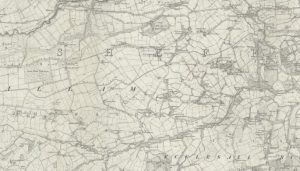
The little label had led from our bookshop in Endcliffe to an Edwardian bookshop in the town centre. But what about the owner – did he live above his premises or was his home elsewhere? It turned out that George Snaith lived out of town in Fulwood’s emerging suburbs. At the time of the 1901 and 1911 censuses, (the period in which the photograph above was most likely taken), George was married and living on Nethergreen Road.
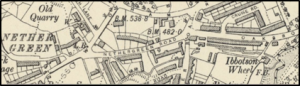
Revised: 1902 to 1903, Published: 1906  Reproduced with permission of The National Library of Scotland

From this point in George’s life, it is worth travelling back along his timeline to see what we can learn about his earlier days. Born in 1857 and the oldest of six children, George came from the Darlington area where his father William was an accountant for the railway. The famous Stockton to Darlington line was the first to use steam locomotives for passenger transport and is viewed as the beginning of our modern railway. Coincidentally, the line opened the year of William’s birth in 1825. Perhaps this gave him an affinity with the railway from an early age. Whether he felt a special connection with the S&DR or not, his white-collar profession would place him in a relatively comfortable social class. That the family employed a servant was another indicator of the Snaith’s social standing.

By the time he was 24 in 1881, George had moved down to Sheffield and was employed as stationer’s assistant, lodging at Gloucester Street in Broomhall. George’s mother Mary was born in Hatfield, near Doncaster, so perhaps this was the connection which led him to south Yorkshire.

Stationery and books have a natural connection and by 1887 George had established his bookshop in Barker’s Pool. A local newspaper advertisement from that year directed readers to Snaith’s Booksellers if they liked the sound of a new publication called “THE CONFESSIONS OF A BACHELOR; and other Sketches” by H. Grafton (“Decidedly amusing…will promote laughter wherever read”). At some point in 1909, when our copy of Fireside Travels was published, it must have made its way into Snaith’s shop and perhaps one of his apprentices, (for which he advertised vacancies), stuck that tiny label inside the back cover.

Newspaper advertisements show that Snaith’s was not only a shop to buy the latest good reads, but also a place where you could buy tickets for events. For example, in February 1904 you could catch “Little Lord Fauntleroy by Mrs Frances Hodgson Burnett” performed at The Albert Hall. In November 1910, you could pop into Snaith’s to buy a ticket to hear the pioneering folk music and dance collector Cecil Sharp give a “Morris and Country Dancing Lecture…with Twelve illustrative Dances”. This event took place at the Temperance Hall and was hosted by the Sheffield Branch of The Teachers Guild.

Although there appears to be no record of George in the 1891 census, it is on record that he married Alice Robinson in the summer of that year. Alice’s family had moved to Sheffield from Buckinghamshire. Her father Edward was a commercial traveller, selling leather goods. At the time of her marriage to George, Alice’s family were living in Sunnybank, in Broomhall. This was the period when George was lodging in Broomhall which suggests there was a local factor in their meeting.

This takes us back to Nether Green, where the couple settled. Snaith’s Booksellers is listed in the 1911 White’s Directory for Sheffield, but George died in March of the following year, aged only 55, sadly providing a sudden end to a journey which began with a bookseller’s label.

Jane Bartholomew, January 2026
Gleanings from the Court Rolls

Back in the late 1990s, Robert Hallam who lived in British Columbia contacted me. He had been researching the knotty problem of Waltheof’s Aula. Some writers had suggested it was located at Burnt Stones, others that it was on the site of the Castle by the river Don. Hallam thought he had found eveidence that the location was on the site of the present day Hallam School.

Our conversations, including at a restuarant when he visited Sheffield, got me intrigued and I spent a few hours at the Local Studies Library looking through printed transcripts of the Court Rolls. From these I wrote up my findings which were duly filed in the attic where they lay for about a quarter of a century.

A few weeks ago, I came across the paper and research notes which were all paper based. I have scanned the document and corrected any OCR errors I’ve found. I have not carried out further research apart from looking at the registers of Sheffield Cathedral which are online and adding dates of birth, marriage and death for the few people in the trees that I am reasonably confident are the same as those named in the register.

I hope that those who know far more about the period (approximately 1550 – 1650) will post comments adding further details and, of course, highlight errors in the original paper.

The paper does confirm that Stumperlowe has been inhabited and farmed for many centuries and the names of the families living in the Tudor and Jacobean periods are still existent today.

The paper is here: Tudor Stumpelowe

Richardson’s Story of Fulwood

This is a small booklet written by Henry Richardson and published in 1931. We don’t know why he wrote it. In its 8 pages, he recounts how some of the older buildings came into existence.

John Henry Richardson was an accountant.He was born in 1862 in Sheffield to Henry, a coal merchant, and Eliza. As a young man he found employment with a firm of Drapers, likely to be J R Robert Ltd with premises at Townhead Street. He married Lavinia Case at the Weston Street Chapel on March 20th 1889 and their first child was born  in 1891. At the turn of the century, Richarson had ceased using his first name and was a cashier at the Drapery store. The family, now with 3 children was living on Crookesmoor Road.

Ten years later, the family was at Nethergreen and in 1912 they moved into No 139 Crimicar Lane. After Henry’s death in 1932, Lavinia continued to lived in  the house, along with her daughter who was a teacher.

It is possible that writing the pamplet was a retirement project for Henry.

I have scanned the document and reproduced it, using different images where approriate but keeping much of the original wording.

The booklet is here

Fulwood gets its own Railway Station – nearly!

The idea was raised by William John Lindley C.E. of Sharrow Lane Sheffield in May 1899. His aims were mostly social, replacing many of the worst slum areas of the city with a brand-new railway, pleasure gardens and land for development of better housing for “reasonable and just conditions of life of the working classes of all degrees.”

The Sheffield Independent carried several letters about the project including one from the proposer indicating his estimated cost to be a little over £1,000,000 and a scheme whereby the capital and interest costs of construction could be recovered.

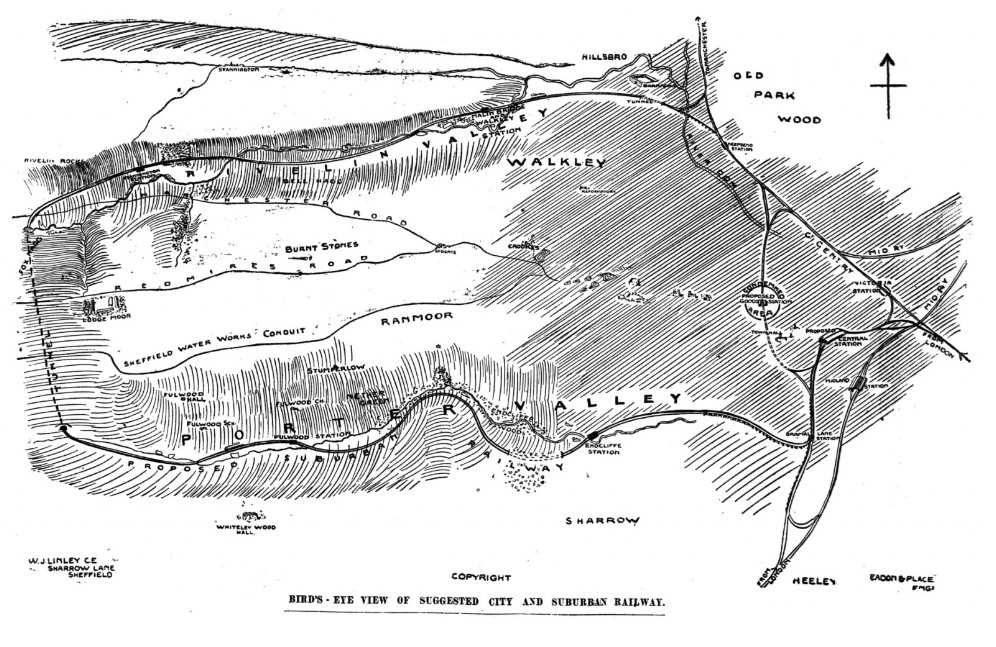
Graphic map of the proposed route

The scheme never received any official support but would have enabled those living in the city to enjoy a trip out to the Porter or Rivelin valleys and return home the same day. Below is shown the proposed route.

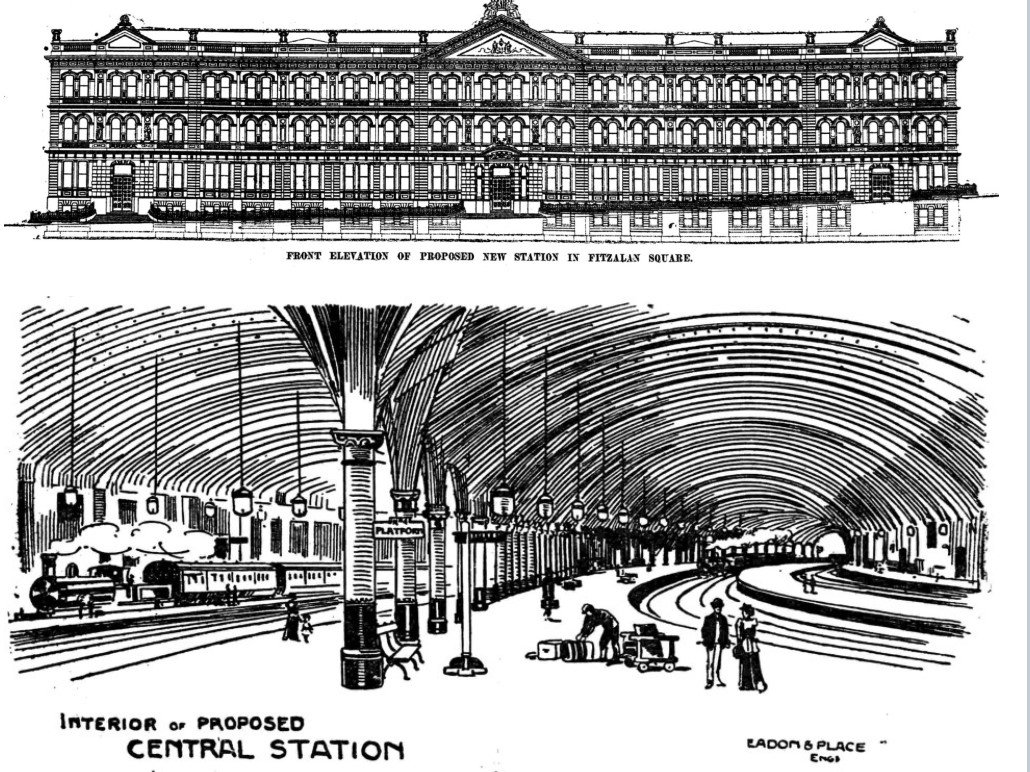
A rather grand new central station was to be built in Fitzallan Square in addition to the Midland and Victoria stations that were already established in Sheffield. The following illustration gives an indication of how it might have appeared:

Ideas for the city centre station

The circuitous route would have involved the construction of several new stations as well as the above. From the new Central Station the line would travel to stops at Bramall Lane, Endcliffe and Fulwood before leaving the Porter Valley to pass through an underground tunnel below Redmires Road, at a point a little way past Lodge Moor Hospital to re-emerge in the Rivelin Valley where it would stop at Stannington so passengers could explore the delights of Rivelin Rocks before passing on to Walkley and Malin Bridge Station. The train would then enter another tunnel before emerging at Neepsend station. It would next call at Victoria Station at the Wicker, which would be the connection to the wider rail network, before returning to the Central Station. No doubt it would have been a pleasant day out on a fine summer’s day.

What would the effects have been on Fulwood if the proposal had been adopted? Probably very little as the tram network was, by 1899, already bringing visitors as close as Nethergreen where they could travel by foot to enjoy an afternoon boating at Forge Dam or one of the other entertainments offered by Herbert Maxfield who owned the Dam site.. Afterwards visitors might enjoy a slice of cake while waiting for the tram at the establishment next to the terminus owned by the Oates family of Fullwood Hall. The only advantage the proposed railway might have had is that the proposed Fulwood station was nearer the Porter. This might have been good for the area of the various dams but Fulwood itself was some way off and up a very steep hill and it is doubtful how many visitors would want, or have time to, explore the delights of Fulwood itself. The site of the proposed station would also have been inconvenient for Fulwood residents at the beginning of the 20th century. If it had been built and was a success though maybe Fulwood would have extended down to the Porter Valley where there would now be shops and housing developments of all times.

The idea perhaps came a little too late. By 1899 railways had certainly lost any novelty value and Fulwood developed along the existing roads rather than around any new railway station.

Alan Crutch
23rd April 2023

Ancient Fulwood

Fulwood was only developed as a suburb of Sheffield towards the end of the 19th century and that, in itself, is an interesting story, but this article is about Fulwood in the dim and distant past. An extract from the 1850/1 OS map reproduced at the end of this short article will give you an idea as to how Fulwood was before it developed as a suburb of Sheffield

Pre-History

The story begins in the Mesolithic age when people were nomadic following the herds of wild animals and collecting nuts, plants and berries. They probably fished in local rivers and streams. An attractive area for both wild animals and early man, Fulwood would, as its name suggests, have been mostly covered in trees with many streams and rivers. Evidence that people were present consists of finds of flint here. A scraper was found in one of the fields below School Green Lane and a microflint was found near to where Blackbrook Avenue currently stands.

The story is similar in the Neolithic Age which began in around 5000 BC. A barbed arrowhead was found in one of the fields near Lodge Lane and another significant find has been made near the road up to Ringinglowe.

People were also here in the Bronze age (c2,500 BC – 800 BC) Yet again the Blackbrook Avenue area seems to have been particularly favoured as there are was evidence of both barrows and cairns in that region, and another near Cottage Lane.

The Roman Period

Enormous stones still form the base of old field walls in this area. These may date back to the Romano-British period (c50 AD – 400AD) and possibly earlier. A marble mosaic, roman pottery and what is described as an opus signium have all been found near Lodge Lane and a Roman coin of Constantine has been found in Stumperlowe. Roman pottery and evidence of a small building have been discovered at the top of Brooklands Avenue.

The Medieval Period

Aerial photographs show that several fields in the area have the ridge and furrow pattern typical of medieval farming and the early Court Rolls for the manor of Sheffield contain numerous references to families that had settled in Fulwood. The oldest names the Lynott family as taking 3 acres of land in Fulwood in 1283. As the Rolls only began to be compiled in the 1270s it is almost certain that this region was lived in and farmed well before that date. The monks from Beauchief Abbey had land in this area and Fulwood Booth is reported as being a place where the Lord of the Manor’s oxen were being raised in the 12th century.

Tudors and later

By the time of the Tudors (from 1485) there were several established families living in and farming land in Fulwood. As their wealth increased several of them seem to have begun to build more substantial houses. In the early 1600s they seem to have been competing as to who would live in the grandest house. Benet Grange, Fulwood Hall, Stumperlowe Hall and Whirlow Hall all seem to have been substantially improved at that time.

The story of Fulwood continues to the present day. In the twentieth century there were plans to run a railway connection to Fulwood and it was also proposed that the South-Western part of the Sheffield Ring Road should pass through Fulwood very near to the field opposite the chapel.

First Ordnance Survey of the area carried out in 1850 and published in 1854 (click on the map to see the on-line map). 

First Ordnance Survey of the area carried out in 1850 and published in 1854 Reproduced with the permission of the National Library of Scotland